
The Brock & Scott Connecticut office enjoyed a night of music by Gabrielle Lakshmi and Tommy Weeks, food, drinks and great company while raising money and supporting the CTBA as a sponsor.
Since the inception back in 2014, the local community has shown what is possible when people come together. Because of the generosity of supporters like Brock & Scott, Brainstormin’ has raised more than $850,000 to provide assistance to patients and families, support critical research and improve the lives of those affected by brain tumors throughout Connecticut.
While Brainstormin’ has evolved, the heart of the event remains the same. It is a night to celebrate the courage of survivors, honor those we have lost, support families facing a difficult journey and come together around a shared mission. The partnership from the title sponsor, The Yale Brain Tumor Center at Smilow Cancer Hospital, helps make this event possible and reflects a shared commitment to improving the lives of patients and families affected by brain tumors.
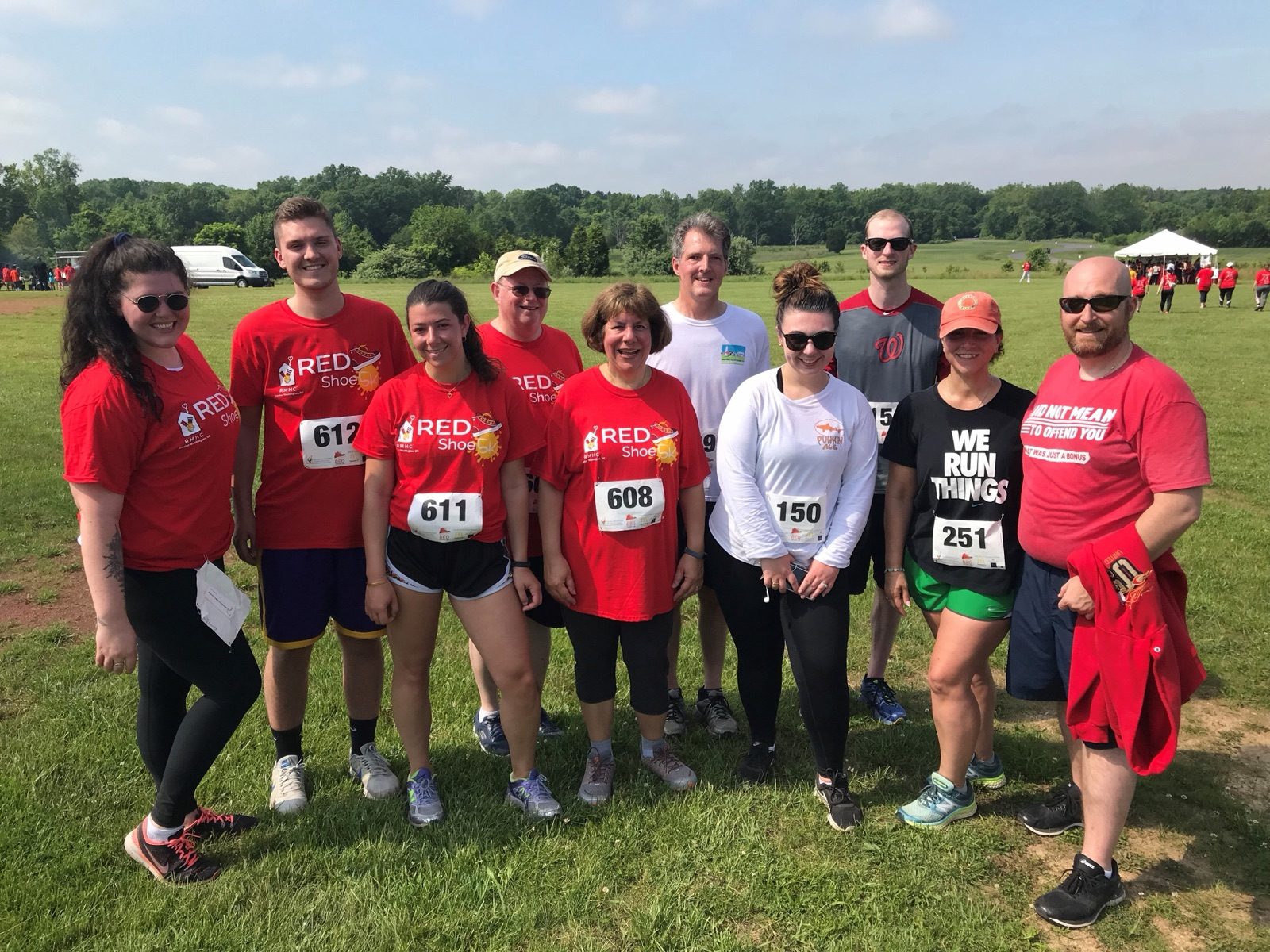
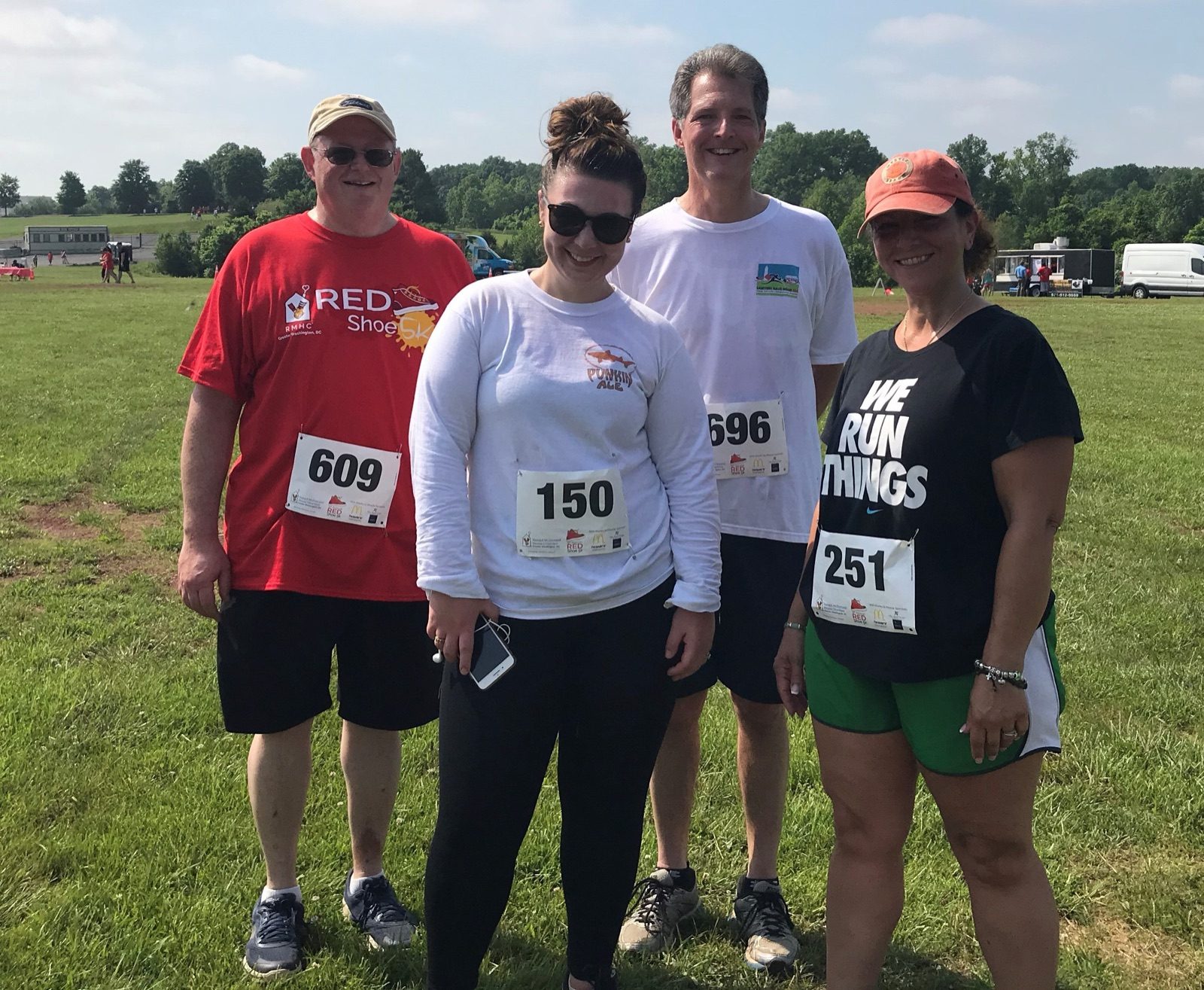
On May 19, 2019, Maryland attorneys, past and present, got together with their families and supported the Red Shoe Run 5K for the Ronald McDonald House of Maryland in Baltimore City. The Ronald McDonald House provides lodging for the families of sick children undergoing medical care at Johns Hopkins Hospital in Baltimore, Maryland. The Red Shoe Run raised $97,000.00.
Well Done Maryland Team!
At the end of 2016, the Supreme Court of North Carolina sent a pragmatically powerful message regarding North Carolina Chapter 45 power of sale foreclosures: the contract is in control. Consequently, the opinion, In re Lucks, 369 N.C. 222, 794 S.E.2d 501 (2016), simplified legislatively created procedures for power of sale foreclosures while also limiting the potential for protracted litigation. How did Lucks put the power back into contractual obligations while restraining judicial interference? What impact have we seen because of Lucks? What impact will Lucks have on future power of sale foreclosures in North Carolina?
FACTS / PROCEDURAL HISTORY
The facts of In re Lucks are as follows: In July 2006, Gordon Lucks executed a promissory note and deed of trust encumbering his property. By 2010, Mr. Lucks had defaulted on the debt by failing to make payments on the loan. In September 2013, the Ford Firm, acting as substitute trustee, initiated a special proceeding for a non-judicial foreclosure under N.C.G.S. § 45-21.16. The foreclosure was “dismissed” for failure to provide evidence the Ford Firm was properly substituted as counsel. In June 2014, Cornish Law, PLLC, acting as substitute trustee for the same deed of trust, initiated a new non-judicial foreclosure for the debt owed by Mr. Lucks. This matter was also “dismissed” because the clerk discovered evidence that the Ford Firm had actually been appointed substitute trustee in the prior hearing, and due to the principles of res judicata Cornish Law could not proceed. Deutsche Bank, holder of the note, appealed the second dismissal and presented evidence demonstrating the right of Cornish Law to proceed with a non-judicial foreclosure. At trial, Deutsche Bank provided a power of attorney (referred to in the opinion as “Exhibit 4”) allowing its mortgage servicing company to appoint trustee on behalf of Deutsche Bank, which would have properly appointed the Ford Firm. However, the copy of Exhibit 4 presented was deemed “internally inconsistent” and the court ultimately “dismissed” the foreclosure based on an objection by Mr. Lucks. The dismissal was appealed and the Court of Appeals reversed the trial court holding that the Rules of Evidence are relaxed for non-judicial foreclosures. Mr. Lucks appealed to the Supreme Court of North Carolina. See In re Lucks, 369 N.C. 222, 794 S.E.2d 501 (2016).
OPINION
The Supreme Court addressed two issues in Lucks: 1) whether the principal of res judicata applies in a non-judicial foreclosure, and 2) whether the trial court abused its discretion by finding Deutsche Bank failed to establish the appointment of the substitute trustee. Id. 228. The Court starts its analysis by establishing that the Rules of Civil Procedure do not apply in a non-judicial foreclosure “unless explicitly engrafted into the statute.” Id. at 226. The General Assembly intentionally crafted Chapter 45 to be a “comprehensive and exclusive statutory framework” for non-judicial foreclosures and not that non-judicial foreclosures are not a judicial action. Id. at 222. As a result, Chapter 45 requires a creditor to prove “its right to proceed” to the court, and the court is charged with whether or not to allow the foreclosure. Id. at 226.
The Court reasoned that a non-judicial foreclosure is a special proceeding used to enforce a contractual obligation and the court’s authority is limited to the elements of foreclosure found in Chapter 45. Id. at 229. The Court recognized the role of “gatekeeper” created by Chapter 45, and accepted that the Rules of Evidence are relaxed for a non-judicial foreclosure. Allowing a foreclosure to proceed requires review of the evidence presented (or objected to) for “competency, admissibility and sufficiency” and this authority vests only with the clerk or trial court. Id. This review is only conducted at the foreclosure hearing since a non-judicial foreclosure is not within the Rules of Civil Procedure (i.e., no “answer” is required to be filed and cross claims are not allowed). The court is charged with review of the borrower’s objections, and, if the evidence is insufficient, the court may prohibit the foreclosure from proceeding. However, a denial by the court does not implicate res judicata in the traditional sense, because, as the Court states, “the Rules of Civil Procedure and traditional doctrines of res judicata and collateral estoppel applicable to judicial actions do not apply.” Id.
HOLDING
The Supreme Court’s conclusion has implications outside of the instant case. It impacts the entirety of non-judicial foreclosure law in North Carolina because a standard now exists that the Rules of Civil Procedure do not strictly apply to non-judicial foreclosures unless expressly provided by statute. The legislature in crafting Chapter 45 seemed to understand that a contractual relationship exists between creditor and borrower. Since creditors are motivated to cease a foreclosure if the debtor reinstates, performs other loss mitigation, or lacks sufficient evidence to proceed, the judicial role should limited. This premise supports the contractual relationship between the creditor and the borrower and the ability to govern themselves as private entities. As such, the legislature intentionally relaxed the Rules of Evidence and the Rules of Civil Procedure for non-judicial foreclosures. Essentially, the opinion in Lucks places the power back into the contract and its enforcement mechanisms (i.e. – the terms of the deed of trust and Chapter 45 of the North Carolina General Statutes). The Court effectively summarized its position in the following two sentences: “Non-judicial foreclosure is not a judicial action; the Rules of Civil Procedure and traditional doctrines of res judicata and collateral estoppel applicable to judicial actions do not apply. To the extent that prior case law implies otherwise, such cases are hereby overruled.” Id.
CURRENT IMPACT / FUTURE IMPACT
The immediate result of Lucks is a change in power of sale foreclosure process before the court. A Chapter 45 power of sale foreclosure sale is now withdrawn by the trustee instead of voluntarily dismissed by either the trustee or the court. As evidenced in the facts of Lucks, a “dismissal” was a judicial tool to cease a foreclosure and power vested in either the clerk or the trustee. As a result of the holding in Lucks, the power is solely vested in the trustee to withdraw the notice of hearing for foreclosure. Although Lucks clearly identifies the clerk’s role is to allow or deny a foreclosure from proceeding, it also limited traditional judicial tools in the clerk’s repertoire. Additionally, the Lucks’ opinion has added a proverbial wall against borrower’s counsel seeking to bind the Attorney/Trustee/Lender’s Counsel at the foreclosure hearing with discovery attempts and/or procedural attacks on the foreclosure that are outside the boundaries set forth by Chapter 45 of the North Carolina General Statutes. It allows an argument rooted in simplicity and pragmatism: “See the Lucks Case.”
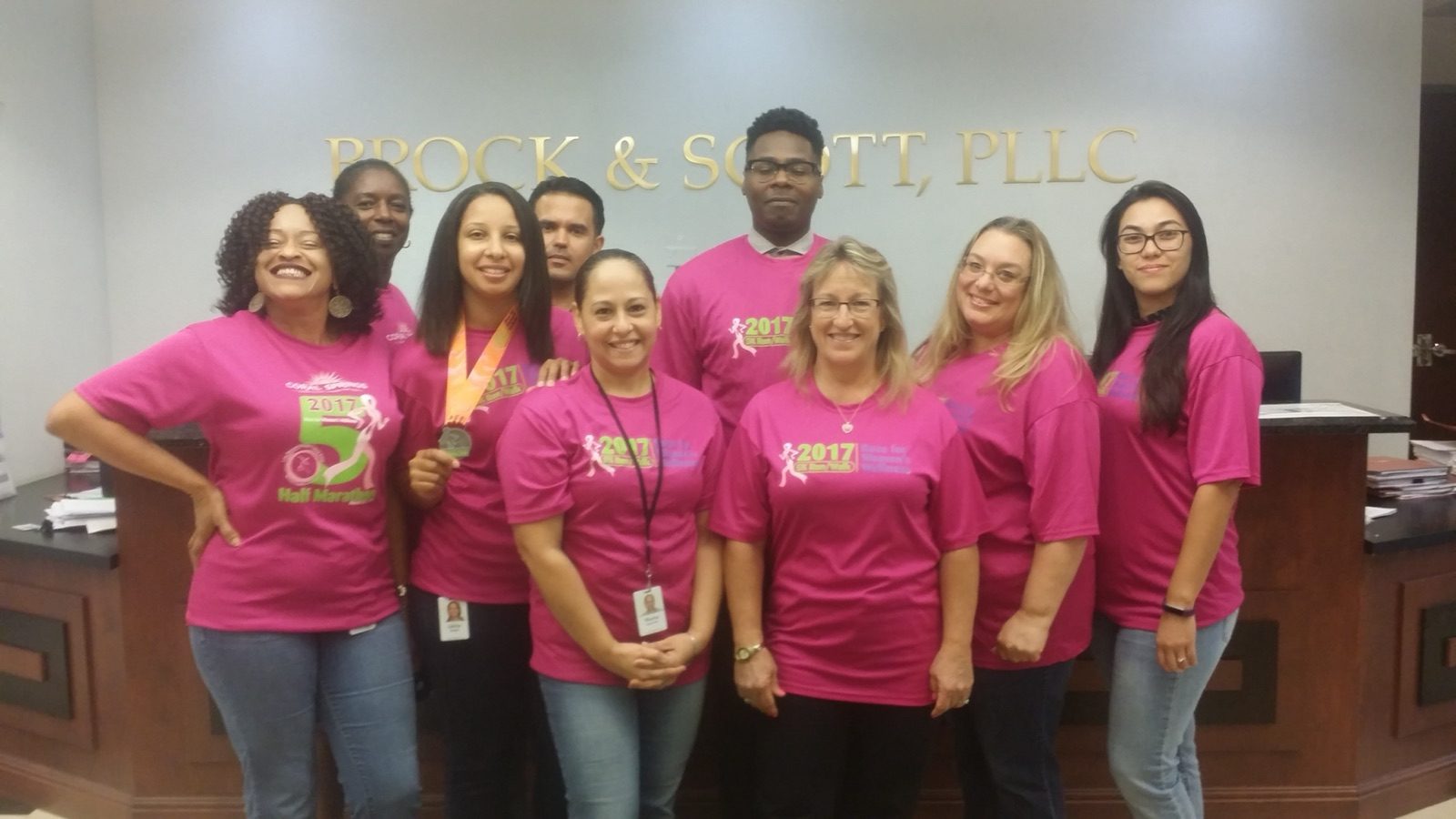
On March 25th, employees from the Ft. Lauderdale office participated in the Race for Women’s Wellness 5K. The race was held in Coral Springs, Florida and the proceeds go to help fight against Breast Cancer. Brock & Scott employees, along with their friends and family members dressed in style to show their support for the cause. Everyone was having fun and looked very pretty in all that pink!

The Brock & Scott race team included the following employees: Adria Smith, David Echavarria, Deborah Tipton, Jimmy K. Edwards, Juliana Shirata, Juliet Steadman, Tina Birgel, Christine Maselli, and Marta Aparicio.